Drink driving offences in New South Wales are graded by blood alcohol concentration, and the range you fall into determines almost everything that follows: the size of the fine, the length of any licence disqualification, whether an alcohol interlock order is mandatory, and whether the matter is finalised by penalty notice or in the Local Court.
This guide explains how drink-driving charges work under the Road Transport Act 2013 (NSW), in the order the process unfolds: the legal limit for each class of driver, the five ranges, random breath testing and breath analysis, immediate licence suspension, the maximum penalties on a first and on a second or subsequent offence, the alcohol interlock program, and the defences realistically available.
Key Takeways
- Drink driving offences in NSW are graded into five PCA ranges by blood alcohol concentration. The range determines the fine, the disqualification period and whether an alcohol interlock order is mandatory.
- Mid-range and high-range are mandatory interlock offences in every case, including first offences, so the section 205 disqualification periods do not apply unless the court makes an interlock exemption order.
- Police can suspend your licence immediately at the roadside for any reason. An appeal must be lodged in the Local Court within 28 days, and lodging it does not stay the suspension.
- Paying an on-the-spot fine gives up the right to argue for a shorter disqualification, for no conviction, and to challenge the reading.
- The alcohol interlock program costs roughly $2,200 to $2,500 per year, plus a licence application fee, often more than the fine itself.
What Counts As A Drink Driving Offence In NSW
Drink driving is not a single charge. It is a family of driving offences, and the offence charged changes the penalties, the disqualification period and the options available to you.
Under the Road Transport Act 2013 (NSW), driving a motor vehicle with more alcohol in your system than your licence permits is an offence of driving with the prescribed concentration of alcohol, almost always shortened to a PCA offence. The prescribed concentration of alcohol that applies to you depends on your licence class and the motor vehicle you were driving, not on whether you felt affected.
PCA offences are strict liability offences. NSW Police do not have to prove that you intended to exceed the legal limit or that your driving was impaired.
Alcohol Offences, Drug Offences and Combined Offences
Alcohol offences under section 110 and drug-driving offences under section 111 are charged separately; however, they are frequently laid together following the same roadside stop. A combined offence under section 111A attracts more severe penalties than either charged alone.
Many people describe all of this as a DUI. In New South Wales, that term is narrower. Driving under the influence is a separate offence under section 112, requiring proof that your driving was affected by alcohol or a drug, and it can be charged without any specific reading. Most people arriving with a number in mind are facing a PCA offence rather than a DUI. If you have been charged under section 112, a DUI under section 112 is a separate charge from a PCA offence. Where illegal drugs are also involved, drug driving is charged separately under section 111.
What is the Legal Blood Alcohol Limit in New South Wales?
Under the Road Transport Act 2013, if you are found to have a BAC concentration above the legal limit, you will be committing what is commonly referred to as a ‘PCA’ (prescribed concentration of alcohol) offence.
These are as follows:
| Novice Range prescribed concentration of alcohol | a concentration of more than zero grams, but less than 0.02 grams, of alcohol in 210 litres of breath or 100 millilitres of blood. |
| Special Range prescribed concentration of alcohol | a concentration of 0.02 grams or more, but less than 0.05 grams, of alcohol in 210 litres of breath or 100 millilitres of blood. |
| Low-range prescribed concentration of alcohol | a concentration of 0.05 grams or more, but less than 0.08 grams, of alcohol in 210 litres of breath or 100 millilitres of blood. |
| Middle Range prescribed concentration of alcohol | a concentration of 0.08 grams or more, but less than 0.15 grams, of alcohol in 210 litres of breath or 100 millilitres of blood. |
| High Range prescribed concentration of alcohol | a concentration of 0.15 grams or more of alcohol in 210 litres of breath or 100 millilitres of blood. |
The novice and special categories overlap in a way most published summaries obscure. A learner, provisional or interlock licence holder is both a novice driver under section 107(1) and a special category driver under section 107(2), so the same driver may fall into the novice range, above zero but under 0.02, or the special range, 0.02 to under 0.05, depending on the reading.
For drivers subject to the 0.02 limit, the consequences are occupational rather than technical. A reading that would be lawful for the driver in the next lane can end a heavy vehicle, dangerous goods or public passenger driver’s ability to work altogether. A common misconception is that in NSW a mechanism called a “work license” exists; however, this is plainly incorrect, which is why understanding disqualification periods can be critical to your employment and work.
Transport for NSW advises that attempting to calculate your BAC from the number of drinks consumed is unreliable because absorption varies with body composition, food, fatigue and elapsed time, and a reading can continue to rise for up to two hours after you stop drinking. For that reason, we do not publish a drinks chart. If you intend to drive, the safest course is not to consume alcohol at all.
Drink Driving Offences NSW: The Five PCA Ranges Explained
Section 108 of the Road Transport Act 2013 sets out five ranges of prescribed concentrations of alcohol. Every penalty discussed below follows from the range you fall into.
Offence | Reading | Who It Applies To | How It Is Usually Dealt With |
Novice range PCA | Above zero, under 0.02 | Learner, P1, P2 and visiting equivalent | Penalty notice available on a first offence, otherwise court |
Special range PCA | 0.02 to under 0.05 | Novice licence holders, unlicensed and disqualified drivers, taxi, bus, coach, heavy vehicle and dangerous goods drivers | Penalty notice available on a first offence, otherwise court |
Low-range PCA | 0.05 to under 0.08 | All other licence holders | Penalty notice available on a first offence, otherwise court |
Mid-range PCA | 0.08 to under 0.15 | All drivers | Court, mandatory alcohol interlock order, imprisonment available |
High-range PCA | 0.15 and above | All drivers | Court, mandatory alcohol interlock order, the longest disqualification periods |
Boundary readings matter more than almost any other factor. The step from 0.079 to 0.08 takes a matter that may be finalised by penalty notice into a mid-range PCA offence carrying a mandatory alcohol interlock order and the possibility of imprisonment. The step from 0.149 to 0.15 again moves into the high range, which is the worst category of drink-driving offences.
Novice Range and Special Range Drink Driving
The novice range applies to a learner or provisional driver with any reading between 0 and 0.02. Special range drink driving applies from 0.02 to under 0.05. A provisional driver can fall into either range, and depending on which applies, the disqualification period changes.
Low Range Drink Driving
Low range covers a reading of 0.05 to under 0.08 for drivers subject to the ordinary legal limit. It is the range in which people most often decide without advice, usually by paying the on-the-spot fine because it appears to be the cheaper option, but it has consequences.
Mid-Range Drink Driving
Mid-range drink driving covers 0.08 to under 0.15. A mid-range PCA offence is a mandatory interlock offence in every case, including a first offence, which is the fact most commonly missed about this range.
High Range Drink Driving
High-range drink driving applies from 0.15 and is the most serious offence in section 110. High-range PCA offences carry the highest fines, the longest minimum interlock period, and a real prospect of imprisonment on a second or subsequent offence, particularly if aggravating factors are present.
From Random Breath Testing to Breath Analysis
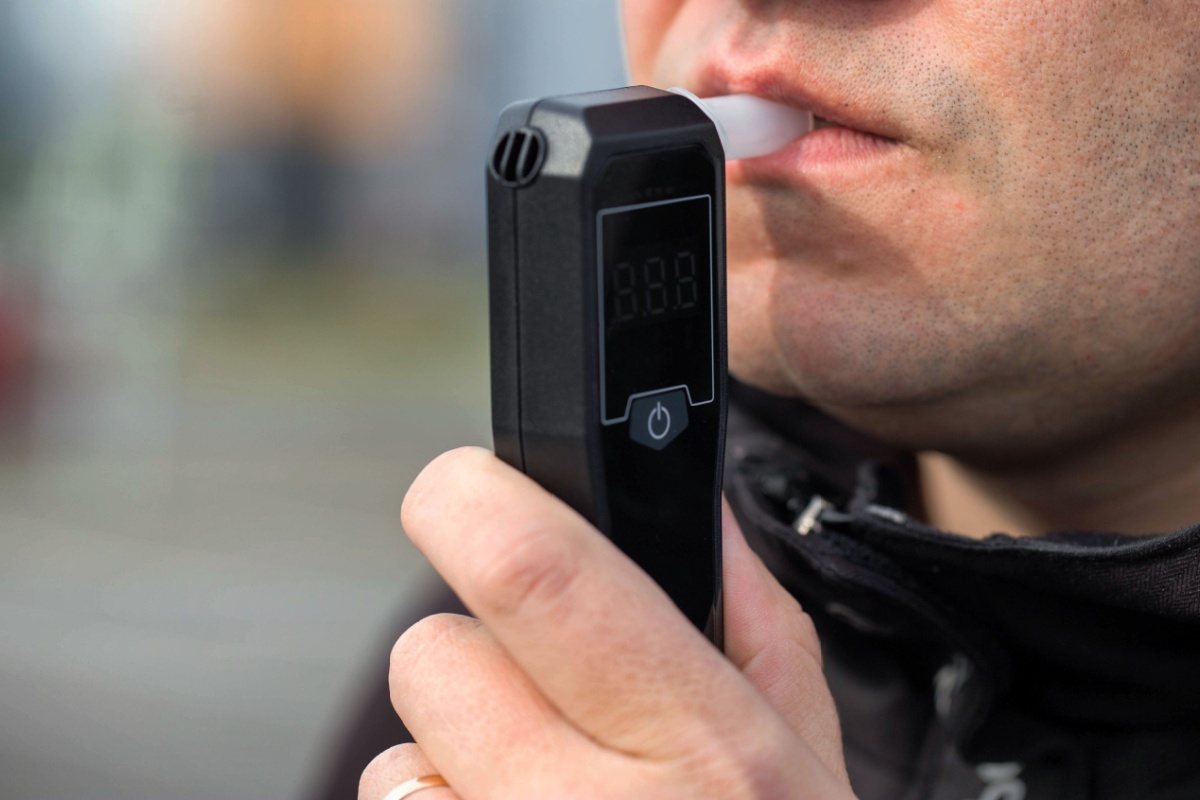
The device used at the roadside during random breath testing is a screening tool, and its reading is not the evidence relied on in court. If the roadside breath test is positive, you will be arrested for the purpose of a breath analysis and taken to a police station or mobile testing vehicle, where a breath-analysing instrument produces the certificate that forms the prosecution case. That second reading, not the roadside one, is the number recorded on your court attendance notice.
Two separate two-hour rules apply, and they are routinely confused. The first limits police power: a breath test, breath analysis or sample cannot be required more than two hours after the driving event. The second governs evidence: where the analysis is carried out within two hours, the reading is taken to be your blood alcohol level at the time of driving unless you prove otherwise. One restricts what NSW Police may do. The other determines what the court presumes. Both sit in Schedule 3 to the Road Transport Act 2013.
Schedule 3 also prevents police from requiring a test, analysis or sample at your home, and restricts testing of a person admitted to hospital or whose injuries would make testing dangerous. The home provision is widely misdescribed online as a defence that operates once you reach your driveway. It is not. It limits the scope of police power.
Refusing or Failing to Submit To A Breath Test
Refusal is not one offence but three, and they carry very different consequences.
What Was Refused (Schedule 3, Road Transport Act 2013) | How It Is Penalised |
A roadside breath test | The least serious of the three, penalised by a fine |
Breath analysis at the station | Penalised identically to a high-range PCA offence |
A blood or oral fluid sample | Penalised by a fine, no imprisonment on a first offence |
The distinction that matters sits in the middle row. Refusing the roadside breath test is a minor offence. Refusing the breath analysis at the station is treated as seriously as a high-range offence, regardless of what the reading would have been.
Immediate Licence Suspension and How to Appeal It
NSW Police can issue an immediate licence suspension for drink-driving offences across every range, including the low range, and you must surrender your licence on the spot. Where you are subsequently required to attend court, the court fixes the licence disqualification period and often backdates it to the day of surrender. Time spent off the road between the roadside and your court date does not count as additional time toward the disqualification. It counts towards it in most cases.
A licence suspension and a licence disqualification are not the same thing. A suspension is an administrative step taken by the police or Transport for NSW. A disqualification is an order made by a court, and it is possible to be suspended without ever being disqualified.
An immediate suspension can be appealed to the Local Court within 28 days. Two features of that appeal are rarely explained. Lodging it does not stay the suspension, so you remain off the road while the application is on foot. And the court must not vary or set aside the suspension unless satisfied that exceptional circumstances exist, which is a demanding test. How the application is framed and supported is most of the work, and how it is argued is equally important.
Penalty Notice or Court Attendance Notice
For a first offence in the novice range, special range or low range, NSW Police may suspend your licence for three months and issue a penalty notice carrying an on-the-spot fine rather than requiring you to attend court. If it is a second or subsequent offence, or the reading falls in a higher range, you must attend court. The NSW Government publishes the current drink and drug driving penalties, including the penalty notice amount, which is indexed and changes on 1 July each year.
Paying the fine is a decision with consequences, not an inexpensive way out. If you pay, you accept the three-month licence suspension exactly as issued and give up the opportunity to argue for a shorter period, to seek a non-conviction, and to challenge the reading.
Electing to go to court also carries cost and risk, including the risk of an outcome worse than the notice and the recording of a criminal conviction. For a straightforward low-range first offence, with no prior record and no occupational reliance on a licence, paying the fine is often sensible. For a driver whose income depends on a licence, or who is facing a second or subsequent offence, it usually is not the case. The election period is short.
Drink Driving Penalties in NSW
The maximum penalties for drink-driving charges dealt with in court vary depending on the severity of the offence and whether it is a first, second, or subsequent offence. Fines are expressed in penalty units.
Offence | Maximum Fine | Maximum Imprisonment | Automatic Disqualification | Minimum Disqualification |
Novice, special or low range, first offence | $2,200 | Nil | 6 months | 3 months |
Novice, special or low range, second or subsequent offence | $3,300 | Nil | 12 months | 6 months |
Mid-range PCA, first offence | $2,200 | 9 months | 12 months | 6 months |
Mid-range PCA, second or subsequent offence | $3,300 | 12 months | 3 years | 12 months |
High range PCA, first offence | $3,300 | 18 months | 3 years | 12 months |
High range PCA, second or subsequent offence | $5,500 | 2 years | 5 years | 2 years |
Every figure in that table is a maximum, and maximum penalties are not typical outcomes. Discretion sits in four places: the length of the licence disqualification between the minimum disqualification period and the automatic disqualification; whether a criminal conviction is recorded; whether an interlock exemption order is granted; and the size of the fine imposed.
Penalties For A Second or Subsequent Offence
The repeat window is five years, not ten. Under section 9 of the Road Transport Act 2013, an offence is a second or subsequent offence where you have been convicted of another major offence within the previous five years, and the harsher penalties above apply from that point. The prior major offence does not have to be the same offence as the one you are facing, and the term “Major offence” captures a range of conduct. This window is unrelated to the ten-year period governing criminal records.
The Alcohol Interlock Program in NSW
An alcohol interlock device is a breath-testing unit wired to a motor vehicle’s ignition. It prevents the vehicle from starting if alcohol is detected and requires further samples while you drive. The program is designed to deter drink driving by separating drinking from driving, and the costs of installation, leasing, servicing, and removal fall on the participant.
Mid-range and high-range offences are mandatory interlock offences in every case, including a first offence, and a second or subsequent novice, special or low-range offence also brings you into the program. For most people facing a mid- to high-range charge, this is the most significant practical consequence.
On cost, the NSW Government Alcohol Interlock Program page estimates the all-in cost at roughly $2,200 to $2,500 a year, covering installation, leasing, servicing and removal, plus an interlock licence application fee. A 35 per cent concession is available to eligible concession card holders, and a hardship program is available for participants who cannot afford the cost.
How Long Does an Alcohol Interlock Order Last
Offence | Disqualification With An Interlock Order | Minimum Interlock Period |
Novice, special or low range, second or subsequent offence | Minimum 1 month, maximum 3 months | 12 months |
Mid-range PCA, first offence | Minimum 3 months, maximum 6 months | 12 months |
Mid-range PCA, second or subsequent offence | Minimum 6 months, maximum 9 months | 24 months |
High range PCA, first offence | Minimum 6 months, maximum 9 months | 24 months |
High-range PCA, second or subsequent offence | Minimum 9 months, maximum 12 months | 48 months |
An interlock driver licence carries a zero blood alcohol concentration condition for the whole interlock period. If you are ordered into the program and do not enter it, section 210 disqualifies you from holding a licence for five years from the date of conviction.
Interlock Exemption Orders
An interlock exemption order is available, but the grounds are narrow, and section 212 is explicit about what will not suffice. As the Judicial Commission of NSW Local Court Bench Book records, an exemption order must not be made merely because you cannot afford the device, because an interlock order will prevent you from driving in the course of your employment, or because the registered operator of the vehicle refuses consent. A limited exception applies to a first offence under section 110(4).
For the mechanics of the program, including the medical certificate process, interlock exemption orders and how the program runs, the details are covered.
Avoiding A Criminal Conviction: Section 10 and Conditional Release Orders
Under section 10(1) of the Crimes (Sentencing Procedure) Act 1999 (NSW), a court that finds a drink-driving offence proven may still decline to record a criminal conviction. It may dismiss the charge under section 10(1)(a) or discharge you on a conditional release order under section 10(1)(b). A conditional release order can also be made with a conviction under section 9. Readers frequently refer to a good behaviour bond. Bonds were abolished in 2018 and replaced by conditional release orders.
In deciding, the court considers your character, antecedents, age, health and mental condition, the trivial nature of the offence, any extenuating circumstances, and any other relevant matter.
One restriction is decisive for repeat offenders. Under section 203 of the Road Transport Act 2013, a section 10 order is not available where a previous section 10 order applied to another applicable offence at the time of determination, or within the five years before it.
The disqualification periods above are mandatory on conviction, which is why the conviction question carries so much weight.
The Traffic Offender Intervention Program
The Traffic Offender Intervention Program is a court-referred education course run over several weeks, covering road safety, the consequences of driving offences and the decisions that lead to them.
Completing the program can improve your sentencing outcome, including on a second or subsequent offence, and a judge can defer sentencing so that you can finish it. Referral generally follows a plea, so the usual sequence is to plead, be referred, complete the course and then be sentenced. Pleading guilty at the earliest opportunity also attracts a sentencing discount, which reduces the sentence the later the plea is entered.
Disqualification Periods: How Long and When They Start
A licence disqualification is a court order that you may not hold or obtain a driver licence, and it is distinct from the administrative suspension issued at the roadside.
A second or subsequent offence within the five-year window moves you into the higher penalties above. A third moves you towards the maximum disqualification period and squarely into the alcohol interlock program, and if a section 10 order was made in the last five years, the non-conviction route is unavailable as well.
Driving while disqualified is a separate offence and carries its own penalties. It is also worth knowing that a good behaviour licence is not available during a disqualification, and the consequences of being caught driving on a disqualified licence are treated far more seriously than most people expect.
Habitual Offender Declarations Were Repealed in 2017
The habitual traffic offender declaration scheme was repealed with effect from 28 October 2017, and no new declarations are made. Section 220 survives, allowing an existing declaration to be quashed where it is a disproportionate and unjust consequence of the offences. Older material stating that three major driving offences in five years make you a habitual offender is out of date. Historically, declarations were repealed in 2017, and existing ones can be quashed.
How Long Does a Drink Driving Conviction Stay on Your Record
A drink-driving conviction is commonly said to remain on your record for ten years. The position under the Criminal Records Act 1991 (NSW) is more precise than that. A criminal conviction becomes spent after a ten-year crime-free period, not a flat ten years. Reoffending restarts the period, and a conviction that attracted more than six months’ imprisonment is never spent.
Drink driving offences are criminal offences in New South Wales. If the court records a conviction, you have a criminal conviction and a criminal record. They are summary offences dealt with in the Local Court rather than indictable offences.
While unspent, a drink-driving conviction will generally appear on a National Police Check. Once spent, it is generally not disclosed, subject to exceptions covering certain child-related roles, some licensing purposes and court proceedings. Where the court proceeds without conviction, there is no criminal record to disclose.
When to Get Legal Advice
Representation does not change your reading. It changes what is placed before the court, and the court’s discretion is where the outcome is decided: the length of the licence disqualification, whether a criminal conviction is recorded, whether an interlock exemption order is sought, whether an immediate licence suspension is appealed within 28 days, the size of the fine, and, where instrument records or the two hour rules are in issue, whether the reading is challenged. That work matters most on a second or subsequent offence, where the range of outcomes is widest.
Hamilton Janke is a Doyle’s Guide Recognised Traffic Law Firm that has represented clients in drink-driving cases across the Hunter and New South Wales for over a decade. If you or someone you know has been charged with a drink-driving offence, contact Hamilton Janke Lawyers for advice today.